



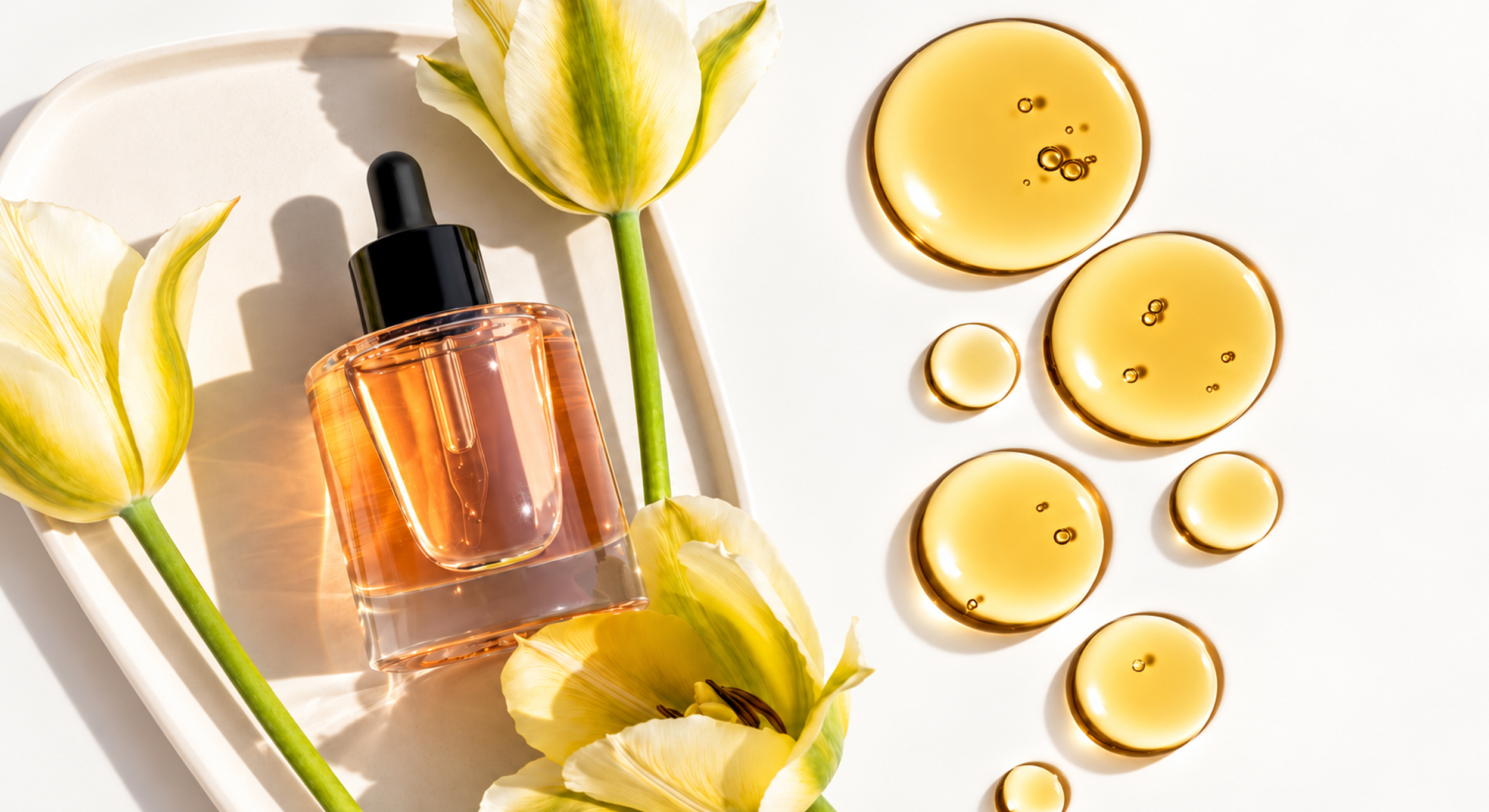
By Robert J. Galamaga
In the February 1998 issue of Les Nouvelles Esthétiques American Edition, I had the privilege and honor of talking about aromatherapy and essential oils. In December 1998, a study I coordinated with the Touch Research Institute of the University of Miami was published in the International Journal of Neuroscience:
Aromatherapy positively affects mood, EEG patterns of alertness and math computations.
According to Copilot Search, as of August 14, 2026, it had been cited 227 times in Web of Science and over 113 times in Google Scholar and had an Altmetric attention score of 451,182. On September 4, 2026, it had been cited 227 times in Web of Science and over 686 times in Google Scholar.
Not only can quality essential oils affect the mental aspect of a person’s being, but they can also have a beneficial effect on the skin, whether over a shorter or longer period of time.
Because of the intense interest in aromatherapy and the use of essential oils, I would like to remind newcomers to the field of skin care and spa professionals of the basic tenets in that article that still apply today.
History reveals that thousands of years ago, essential oils were highly respected and used as perfumes, cosmetics, and medicines. In fact, essential oils are mentioned in the Bible, and throughout the world’s church services during the Christmas season, everyone can experience the smell of frankincense.During the Middle Ages, when plagues were rampant, some of the gravediggers wore cloves of garlic to ward off the “evil” spirits, diseases, and plague. They were the ones who survived.
With the explosion in the number of websites devoted to aromatherapy, most people may know that René Gattefossé coined the term “aromathérapie” in 1928. He began to study the medicinal effects of using plants after, several years earlier, he had burned his hand and thrust it into a vat of lavender essential oil and observed the wound heal in an unusually short period of time.
Everyone should now know that true essential oils are the result of steam distillation and the collection of the liquid essences extracted from plants, trees, and flowers. Different parts of the world, “Prized Localities,” to quote Dr. Jean Valnet, provide a better growing environment than others. Essential oils are different from carrier oils, such as grapeseed or evening primrose, to name a few. Carrier oils are obtained by crushing or pressing the seeds to produce their oil.
There are different grades of essential oils. A lavender fragrance oil is not an essential oil but a synthetic chemical compound that smells like lavender. There are also different grades of carrier oils.
Legalities on Use
This article is not intended to give specific legal advice, as each matter is different, and each state has its own particular laws.
“You, as a professional, and your employer are exposed to a lawsuit for your professional actions or inactions and can and will be successfully sued if your actions or inactions cause injury to another.”
Obviously, this statement applies to all of your professional activities and is not just limited to the use of essential oils, should you use them in your practice. How do you avoid being successfully sued or losing in the courtroom? The simplest, though most complex, answer is “Do not do anything wrong.”
If you are interested in using either aromatherapy or essential oils, or if you are already using either modality (and they can be different) in your business, my advice would be to be properly informed and educated before you begin or continue offering those services.
Education
How or where do I learn about using essential oils?The answer to this question, at least in Florida, is very difficult to give, as there is still no state recognition or licensing of “aromatherapists, aromatologists, or aromacologists.”
Accordingly, no standard of reference exists upon which to make a decision. While it is not an easy or quick task, unless a person specifically knows of someone who is reputed by trusted and informed friends or professionals to be a knowledgeable teacher in the use of essential oils, I recommend that you read as much as you can.
Before a person starts using essential oils or picks a person who is going to direct the initial studies, at least two or three books on aromatherapy should be read. This will give the prospective student an idea of the questions to ask the person who is presenting the class so that an initial impression of the teacher’s qualifications can be made.
Before Using Essential Oils
Before using essential or aromatherapy oils in skin care or recommending one to be used in baths for relaxation, the esthetician must know the properties of the oils. Just because they are natural does not automatically make them safe to use.
If a client is on blood thinners because of a medical condition and the oil is known or reported to promote blood clotting or thinning, it obviously should not be used.
The esthetician must also have a general knowledge of his or her client’s medical condition and medication history to ascertain if there are any contraindications to using a certain oil or synergy with that client. (A synergy is a blend of two or more essential oils that results in a completely different chemical composition than the two individual oils.)
If you are selecting and blending the essential oils to be used in a synergy and mixing the essential oil(s) with the carrier oil, you can now be considered “a manufacturer,” with all of the legal obligations and liabilities of a manufacturer.
Contraindications
The following contraindications should concern you if you plan to use essential oils. The client must be fully apprised of, or told about, all contraindications to the use of essential oils, even if this means the loss of a sale.
If your client:
– Is pregnant: While stretch marks can be minimized with the use of certain oils, permission from the doctor must be obtained before using essential oils. I do not recommend that anyone who is pregnant use essential oils unless they have been approved for use by a qualified health care practitioner.
– Is epileptic: I do not recommend that anyone who has this condition smell or apply essential oils, as certain essential oils can cause such a person to suffer a seizure.
– Has high blood pressure: Permission from the doctor must be obtained before using an essential oil, especially if the person is taking medication. I do not recommend that anyone who has this condition smell or come into contact with certain essential oils, as exposure to certain essential oils, such as peppermint (Mentha piperata), will cause such a person to suffer a rapid increase in blood pressure as a result of exposure to the essential oil.
– Has low blood pressure: Again, permission from the doctor must be obtained before using essential oils, especially if the person is on medication. Certain essential oils, such as ylang-ylang (Cananga odorata), will immediately lower blood pressure.
– Is taking medication or is under a doctor’s care: Permission from the doctor must be obtained before using essential oils. Essential oils can increase or decrease the effects of the medication your client may be taking, and their doctor should be made aware of what the patient is going to use and give clearance for its use.
– Is an infant or young child: I generally do not recommend using essential oils at all on children under 13 years of age. (The before-and-after photos of the 21-month-old child followed a stringent course of using essential oils, with the dosages greatly modified.)
– Is drinking an excessive amount of alcoholic beverages: I do not recommend using essential oils.
The above list is not exhaustive but demonstrates some major contraindications, or situations in which essential oils should not be used.
Who Can Use Oils
Can I use essential oils in my practice as an esthetician?As an esthetician, you may use essential oils in your practice. You can make essential oils available, provided that you do not overstep your bounds; i.e., you cannot represent yourself as providing a product that is going to “cure” a particular ailment. Simply put, you cannot practice medicine or dispense a drug.
If you do use essential oils, I feel that you have a duty to let your client know what the particular essential oil has historically been known to accomplish. Because of the overlapping properties of the oils, perhaps you may want to have aromatherapy reference materials available for the curious client to review so that he or she is fully aware of the properties of the oils.
Remember that each time you manually apply an essential oil or synergy to a client, you are also being exposed to the oils contained in the synergy. At the end of a busy day, you may have overloaded your own body’s systems, so you need to monitor this carefully.
Certification
What is “certification” in the use of essential oils, and what does it entitle me to do in the U.S.?Certification means that someone has undergone a course of study with a particular entity and has met that particular entity’s criteria, demonstrating that the course has been successfully completed.
If you are not otherwise qualified, such as being a licensed medical provider who is able to dispense a drug, being a certified aromatherapist does not give you the legal ability to prescribe and apply a certain essential oil or synergy to heal a certain medical condition. You cannot practice medicine or dispense a drug.
Type, Quality, and Grade
One author, years ago, stated that the fragrance of an essential oil is one way to tell if the oil is of therapeutic quality. “Just like fine wine, if it doesn’t smell right, send it back.”
Be careful, though. With the sophisticated use of chemistry, synthetic oils can be constructed to smell the same as, or even better than, a natural essential oil.
Quality essential oils are rated in grades of 1, 2, 3, and so forth. Most of the essential or aromatherapy oils that are found in the general marketplace, even though represented as “pure” or therapeutic-grade essential oils, are not grades 1 or 2.
There is no recognized source that can qualify an essential oil as “therapeutic,” as “therapeutic” is just a marketing term. If the essential oil is obtained from the tenth distillation of the harvest, it can still be called “pure” but does not have the properties of grade 1 or 2 oils.
An example I use is:
“If you take a whole chicken carcass and gently boil it in 6 inches of water for 4 hours, what do you have? Pure chicken broth. Now, take that same carcass and boil it in 50 inches of water for 30 minutes. Yes, you still have pure broth.”
While some essential oils have been certified as “organic,” unless they are actually harvested from plants that have been hydroponically grown in a greenhouse, they may not be shielded from unwanted pesticides, etc.Why? Because of acid rain and wind, like the wind that brings Saharan dust to South Florida every summer. “Organic” is also a great marketing term.
You Are Liable
Finally, history reveals that over the centuries, essential oils have successfully helped maintain and preserve healthy, attractive skin of all ages.There is now a general awareness of the benefits of using quality natural substances (grades 1 and 2 of essential oils), which, though difficult to find, are available. The esthetician should be properly educated before using the oils.
If the esthetician intends to use essential oils without having the proper training, he or she may be exposed to civil liability should an adverse or unwanted effect take place.While the use of essential oils may not give the client an “immediate” fix, essential oils are known to help maintain and preserve healthy and attractive skin.
About the Author
Robert J. Galamaga received his J.D. from the University of Miami and has been a member of the Florida Bar since 1974. In 1994, he commenced his studies of essential oils and, in addition to his private litigation practice, became corporate counsel for Miami Aromatherapy, Inc. and High Def Skin, Inc.™ since their inception more than 30 years ago.
In 2001, when Miami Aromatherapy became an approved Florida CEU provider for massage therapists (#50-1341), he became its Director of Education.
As High Def Skin’s™ corporate counsel, he is assisting it in launching its new website, highdefskin.com™, and its YouTube channel: https://www.youtube.com/@HighDefSkin.He can be reached by writing to him at maioils.com or P.O. Box 432510, Miami, FL 33243.The before-and-after photos are used with the permission of Miami Aromatherapy, Inc.
Read More…
-

The Experience Economy: Why Clients Want More Than a Facial
31 October, 2026 -

The Forgotten Areas: Neck, Décolleté, Hands, and Body
31 October, 2026 -
Essential Oils, Almost 29 Years Later
31 October, 2026 -
Beyond the Face
31 October, 2026 -

The Holiday Booking Conversation Starts Now
30 September, 2026 -

Make Memberships Feel Relevant in Fall
30 September, 2026 -
Are Seasonal Specials Actually Profitable?
30 September, 2026 -

The Treatment Room Upgrade Guide
31 August, 2026 -

The New Era of Skin Analysis
31 August, 2026 -
High-Tech, High-Touch
31 August, 2026