


By Samantha Garcia
How to Invest in Technology That Actually Grows Your Business
Walk any esthetics trade show floor and it is easy to feel like your treatment room is suddenly missing something. There is always a new device promising better results, faster treatments, increased revenue, or an entirely new category of services. LED, microcurrent, microchanneling, nano-infusion, oxygen systems, advanced skin analysis, radiofrequency, ultrasound, and multifunctional platforms are becoming increasingly accessible to estheticians.
How to Invest in Technology That Actually Grows Your Business
Walk any esthetics trade show floor and it is easy to feel like your treatment room is suddenly missing something. There is always a new device promising better results, faster treatments, increased revenue, or an entirely new category of services. LED, microcurrent, microchanneling, nano-infusion, oxygen systems, advanced skin analysis, radiofrequency, ultrasound, and multifunctional platforms are becoming increasingly accessible to estheticians.
Technology can absolutely elevate a practice, but purchasing a device simply because it is trending does not guarantee that it will grow your business.The best device is not necessarily the newest, most impressive, or most expensive one. It is the device that makes sense for your clientele, complements the treatments you already perform, fits into your space, and creates enough demand to justify the investment.Before asking, “What’s the hottest device right now?” ask a much more valuable question: “What makes sense for my business?”
Start With the Clients Already in Your Treatment Room
Before researching devices, start by researching your own clientele.What concerns are you treating repeatedly? What are clients asking for that you currently cannot provide? Where are you seeing limitations in your existing protocols?An acne-focused esthetician may have completely different technology needs than an esthetician whose clientele is primarily interested in aging well, facial sculpting, pigmentation, or event-ready skin. A solo practitioner specializing in holistic treatments will also approach technology differently than a med spa with multiple providers and a high-volume treatment model.
Your booking history can offer valuable insight. Look at your most popular treatments, your most common consultations, and the concerns clients bring up repeatedly. A strong investment should help you solve a problem that already exists within your business rather than forcing you to create demand for a service your clientele may not want.
Look at Your Treatment Menu as a Whole
A device should strengthen your menu, not simply make it longer.One of the most important questions to consider is how naturally the technology fits into what you are already known for. Ideally, a new device should enhance existing treatments while also giving you opportunities to create new ones.
For example, a modality that can be incorporated into several facial protocols may offer more flexibility than a device that can only be used for one highly specific service. The more ways you can thoughtfully integrate the technology, the more opportunities you have to generate revenue from it.
This does not mean adding a device to every facial simply because you own it. Technology should have a purpose within the protocol. The goal is to create treatments that feel intentional, not crowded.
Calculate the Real Cost of the Investment
The purchase price is only the beginning.Before committing to a device, understand what it will actually cost to operate. Does it require single-use tips, cartridges, conductive products, replacement parts, proprietary serums, or other consumables? Is there an annual service fee? What happens if the machine needs repairs? Is training included, and will additional certifications be required?
Then consider how much you can realistically charge for the treatment.If a device costs $10,000 and you generate $100 in profit each time you use it, you would need approximately 100 treatments to recover the initial investment, before accounting for other expenses associated with operating the device.That calculation alone can change the way you evaluate technology.Instead of focusing solely on potential revenue, consider how quickly you can realistically reach your break-even point based on your current booking volume.
Think Beyond the Standalone Treatment
One of the biggest mistakes an esthetician can make is purchasing an expensive device and building only one service around it.A versatile piece of technology can potentially generate revenue across multiple areas of your menu.
It may become the foundation of a signature treatment, but it could also be incorporated as an upgrade to an existing facial. Clients working toward a specific skin goal may benefit from a treatment series. Members may receive preferred pricing on the modality or have it incorporated into a higher membership tier. Combination protocols can pair the technology with complementary techniques, while seasonal and pre-event packages can introduce the service to clients who may not initially book it on its own.The question becomes not simply, “How much can I charge for this treatment?” but, “How many ways can this technology responsibly support my business?”That shift can dramatically change the potential return on an investment.
Consider Training, Confidence, and Support
Technology is only as valuable as your ability to use it well.Before purchasing, find out what education is provided. A quick demonstration of how to turn on a machine is very different from comprehensive training on indications, contraindications, settings, treatment planning, sanitation, troubleshooting, and combination protocols.
Also consider what happens after the purchase. Is there someone you can contact when you have a question six months later? Does the company provide continuing education? Are protocols updated as the technology evolves?
A device sitting unused in the corner of a treatment room has no ROI. The more confident you are in understanding the technology, explaining it to clients, and incorporating it into customized protocols, the more likely you are to actually use it.
Don’t Forget the Treatment Room Itself
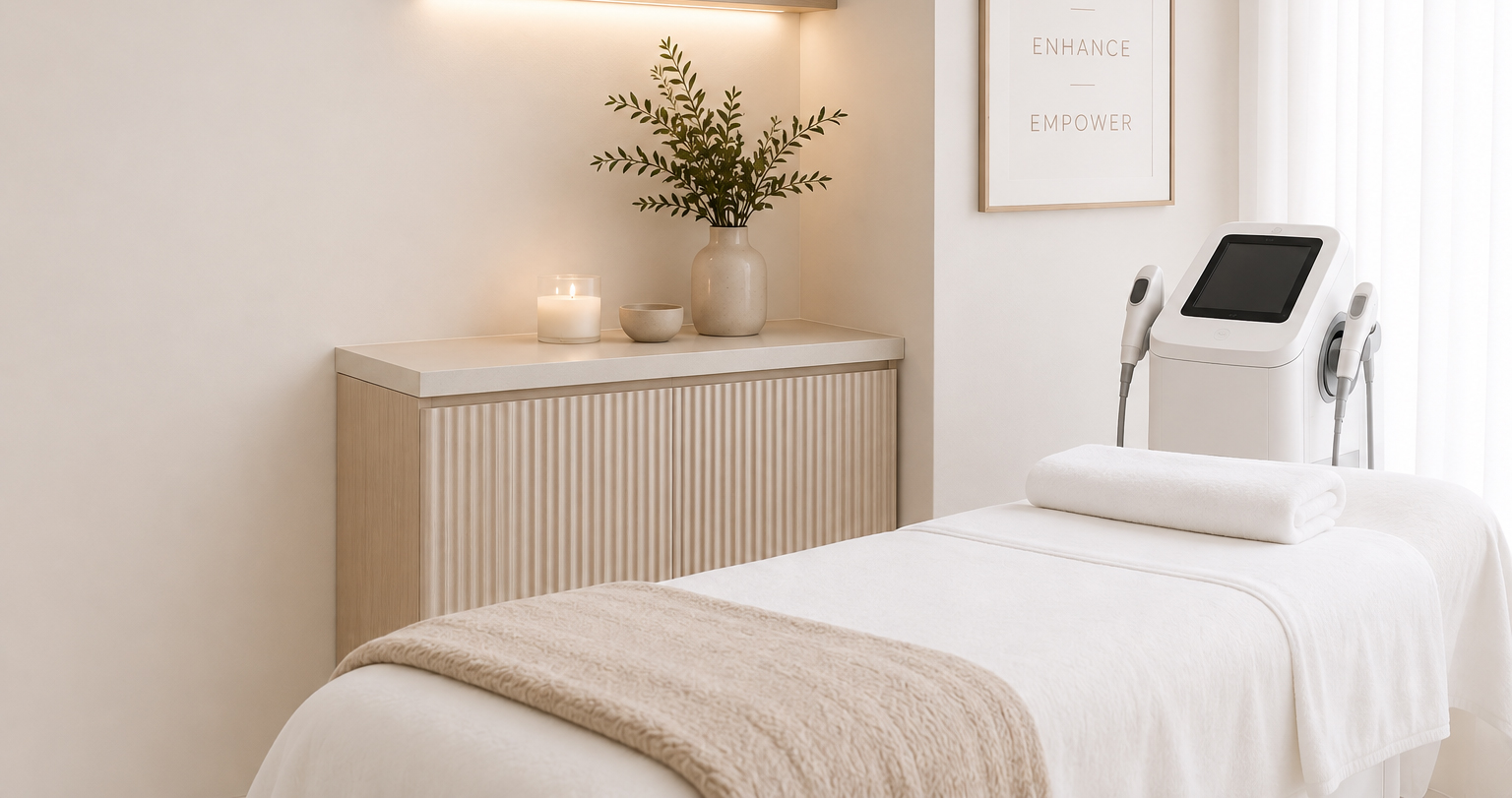
Sometimes the most practical considerations are the easiest to overlook.Where will the device live? Does it require a cart? How much counter or floor space does it take up? Does it need to remain plugged in? How easily can you move around it while performing a treatment?
In a small treatment room, adding too much equipment can quickly affect the flow of the space. Clients should not feel as though they are walking into a storage room for machines.Think about the physical experience of using the device from beginning to end. If setting it up, moving it, sanitizing it, and storing it adds significant time between appointments, that should be part of your investment decision too.
Make the Device Work for Your Brand
Finally, consider whether the technology aligns with the experience you want to create.Not every successful esthetician needs the same devices. Your technology should support your philosophy rather than determine it.If your brand is known for corrective skincare, perhaps technology allows you to deliver more targeted protocols and track measurable progress. If your practice centers on luxury and relaxation, a device may provide advanced results while still fitting seamlessly into a high-touch experience. If you specialize in acne, your investments may focus on technologies that complement the treatment plans your clients are already following.
There will always be another machine, modality, or innovation gaining attention. The goal is not to collect technology. It is to build a treatment room where every tool has a reason for being there.The smartest upgrade is the one your clients need, your business can support, and you are excited and educated enough to use consistently. When those pieces align, a device stops being another expense in the treatment room and becomes an investment in what your business can offer next.
Read More…
-

The Treatment Room Upgrade Guide
31 August, 2026 -

The New Era of Skin Analysis
31 August, 2026 -

High-Tech, High-Touch
31 August, 2026 -

Why Emotional Safety Is Becoming the New Luxury
31 July, 2026 -

Creating Signature Rituals That Define Your Brand
31 July, 2026 -

KPIs Every Esthetician Should Track Monthly
30 June, 2026 -

How to Calculate Your Hourly Worth as an Esthetician
30 June, 2026